

Three wire crates ago I had sworn off the whole category. The first one I bought lasted a year before a latch pin bent and the door would not stay shut. The second one rattled so badly on the drive back from our daughter's place that I pulled over twice to make sure the floorboard was not coming apart. Then my border collie mix Gus chewed the corner off the plastic airline crate we switched to, and there I was in the pet aisle again, three crates in and no closer to a keeper.
That is how this MidWest 30-inch double door iCrate ended up in my cart that afternoon. I bought it out of resignation more than hope, same 49 lbs spot on the shelf, familiar price. I will be honest with you the way I would be across the fence: five years later it is still here, still square, still latches first try, and it has outlived every other crate we have owned combined. That surprised me enough to write this all down.
The Quick Verdict
A plain, sturdy wire crate that does exactly what a crate should for years and holds its shape doing it. It is not fancy and it will not be, but five years in, it is the easy money.
Amazon Check Today's Price →After five years and three failed crates, this is the one that survived two dogs
The MidWest 30-inch double door iCrate has held up through daily use, travel, and two medium dogs who treat crate bars like furniture. If you are done replacing flimsy crates every year, this is the long-haul pick.
Amazon Check Today's Price on Amazon →How I've Used It
To be clear about the exact setup, this is the 30-inch size for medium breeds, roughly 21 to 40 lbs. In our house that covers both dogs: Molly, a 30 lb beagle mix who has hip dysplasia on one side and likes to fold herself into a ball that should not fit, and Gus, my 38 lb border collie mix who is the reason we will probably need a schedule of crate repairs.
The crate has done four jobs across those five years. It is Molly's daytime den while I work orders from my shop. It travels with us folded flat in the back of the truck on every trip to the coast. It corrals Gus during the ten minutes each evening when we put down food and he decides the whole house is his buffet. And it has served as time out, crate rest after Molly's dysplasia flare in 2024, and once as a very expensive pen for a sick kitten we did not plan on keeping.
That last one matters more than it sounds. A fabric crate would have been shredded in a weekend by Gus's nails and that foster kitten's. A crate that you actually keep running for half a decade ends up handling jobs you never bought it for, so the cheap panels and thin wire of my earlier crates never stood a chance.
The Double Doors Are Not A Gimmick
I did not buy this crate for the two doors. I bought it because it was on the shelf and the price was right. The double doors turned out to be the detail I would not give up now, and I did not see it coming.
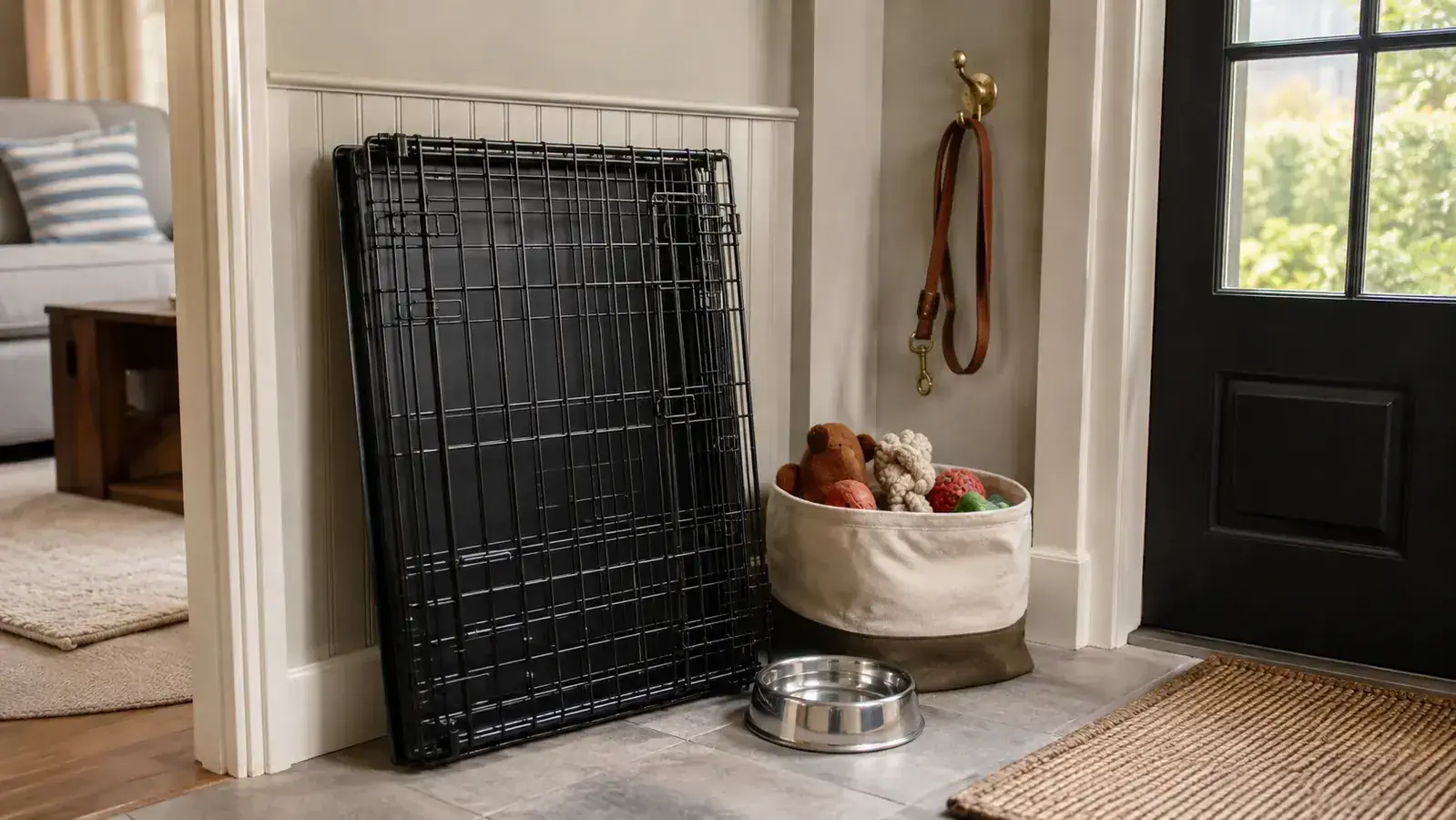
The main door is on the front and swings open wide enough that Molly climbs in without ducking. The second door on the side is the one that earns its keep. When you set the crate lengthwise against a wall, and nearly everyone does, that side door is the opening not pressed against the drywall. It is how I reach in to change the bowl without crawling, and it is how the crate works in the truck. Set front-first against the cab and load from the side.
The latches are worth calling out because they are the part that killed my first two crates. The MidWest uses a two-prong slide latch on each door that clicks into place and stays. Five years in, neither has bent, neither sticks, and neither has popped open on a drive. The pans slide out the front for cleaning, and both doors swing flat if you need them out of the way.
Where the side door really pays off is a narrow hallway, which is how ours spent most of its first year. In our old house the crate sat lengthwise across the end of a hall barely wide enough for Molly to stand and turn around. With only a front door you would be reaching past the dog and over the rim to do anything, and you would be wedging yourself between the crate and the opposite wall to do it. That side door meant I could kneel in the hallway opening, get a hand in at dog level, and settle a pacing Gus without getting on the floor myself. It sounds like a small thing until your knees make the case for you, and mine have after all these years.
The Divider Panel And Room To Grow
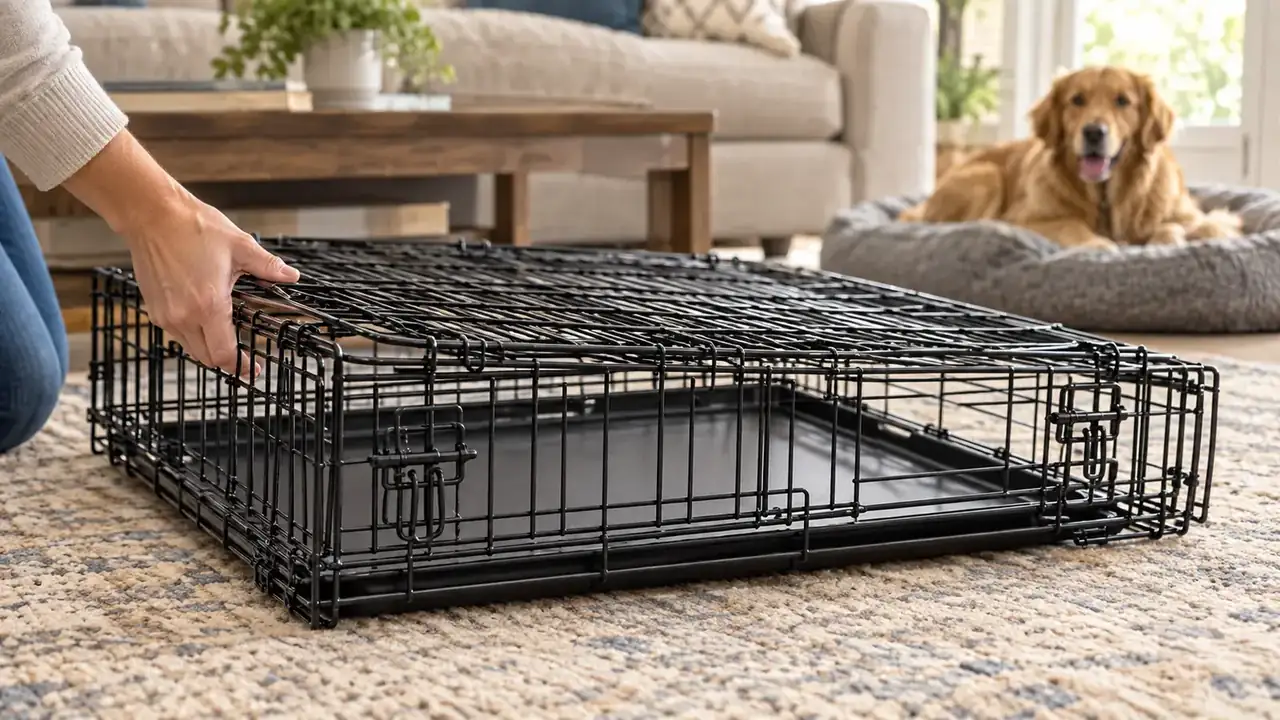
Because we bought this crate for two adult dogs we never needed the divider that came with it, but I have loaned the crate to our younger daughter twice for a growing puppy, and the divider earned its keep both times. The MidWest ships with a metal panel that clips across the back so you can start a pup in a small, den-like space and slide it back toward the door as the dog grows. That single panel keeps a crate a practical size for a 12-week-old puppy and for a fully grown 40 lb adult years later, which is a lot of service from one folding piece of wire.
The divider takes about thirty seconds to move, and the clip-on design means you are not hunting for tools or a screwdriver at six in the morning. I mention that because the two of you who read reviews at that hour know exactly why it matters. It is a small, unglamorous feature, but it is the difference between buying one crate for a puppy's whole lifetime or buying three crates as the dog grows out of each one. That is where MidWest quietly saves you the money that the fancy crates spend on their looks.
Five Years Of Build Quality
The honest measure of a wire crate is not how it looks on day one. It is how square it still is on day 1,800. My first cheap crate went trapezoidal within months, doors sagging, wire panels bending at the corners where Gus pushed against them.
This one has held its rectangle. The wire is thicker than the skin of my old crates and the welds at the corners have not cracked. The powder coating has chipped in two small spots, one on the rear panel where the folding latch rubs and one low on the front where Molly's toenails find it every single day, but there is no rust spreading from either, a detail that matters in a house where crates live near the mud room and the dog bowls.
Neither dog has put a dent in it either, and that is the part that still surprises me. Gus weighs 38 lbs and throws himself into the door when a squirrel passes the window. Molly leans her whole shoulder against a panel when the food bowl is late. Five years of that, and the MidWest has never bowed, never rattled loose at a joint, never turned into the leaning tower my last crate became. I did not expect a wire crate to be the most unkillable thing in the house, but here we are.
It folds flat properly and re-erects the same width every time. There is no wrestling to get the panels to seat, which is the thing I dreaded about travel. The whole thing goes flat in about twenty seconds and comes back up in under a minute. For a crate that has been folded and unfolded at least a hundred times, that consistency is the durability proof.
The travel part deserves its own line, because a crate that folds well but sits heavy in the truck is still a crate you leave at home. Ours rides folded flat against the side of the truck bed under a tarp on every trip to the coast, and when we get there it goes back up in the camper in under a minute. We have had it bounce down dirt two-tracks at highway speed and it has come out of the truck as square as it went in, still latching clean. That is the kind of proof you cannot get from a day-one review.
What The Five Years Cost Us
Every review owes you the honest ledger, so here is mine. We have replaced the plastic drip tray once, after Molly's dysplasia flare in 2024 put her on crate rest and she had an accident that no amount of scrubbing could save. That tray cost us about twelve dollars and shipped in a week. We have never replaced any wire part, any latch, or any hinge.
The crate is not silent, and I will not pretend it is. When Molly shifts at night, the drip tray and the wire panels make a metallic settling sound. In a quiet bedroom that would bug some people. Ours lives in the living room and the truck, so it has never bothered us, but I want you to hear it here rather than find out on night one.
The other cost is that it is a wire crate, which means it does not double as a den the way a solid or fabric crate might. Molly would happily sleep with a blanket over the top in winter. It is a cage on casters, functionally and honestly. The warmth and the cozy factor are up to you to add with a pad and a cover.
Cleaning A Wire Crate In A Multi Pet House
A multi pet house generates mess on a schedule, and the crate world is no exception. There is a foster kitten, a cat that naps on the crate roof when the dogs are out, spilled water from fifteen years of dog bowls, and occasional crate-rest accidents. None of it has ever required this crate to go to the dump.
The slide-out pan wipes clean with a vinegar solution in about four minutes, no corners that trap mess. The wire comes clean with a hose and a rag. Compare that to the fabric crate we borrowed from a friend, which took the smell of one wet day and never truly gave it back. Five years of this routine and the only thing we retired is that one tray.
I would not say I love a crate. I would say this is the first one that has ever quietly survived being an actual working tool in a busy house for five years.
Why Wire Beat Fabric Here
I have used both, and the distinction came into focus the week our foster kitten arrived. The fabric pop-up crate is lighter and prettier, and for a calm dog and a tidy house it is genuinely easier. But it is not airy, it is not chew proof, and once it takes a smell it keeps it.
The wire crate gives airflow that matters more the warmer the summer gets, and it is transparent, which for crate training is the whole game. A nervous dog watches you, sees that the door is open, and settles faster than one staring at a fabric wall. Neither one is wrong, but for daily, wash-mess, chew-prone, travel-and-back use in a house like ours, wire has now outlasted every other option by a wide margin.
What I Liked
- Two solid doors, one on the side, that make setup against a wall and loading in the truck genuinely easier
- Latches and welds that have held five years of daily use and folding without bending or sticking
- Folds flat and re-erects square every time, about twenty seconds each way
- Slide-out pan that wipes clean fast and one replacement part that is cheap and easy to find
- Solid airflow and visibility that make it a better tool for crate training than a fabric or solid crate
Where It Falls Short
- It makes a metallic settling sound when a dog shifts, louder than a fabric crate in a quiet bedroom
- A bare wire crate is not warm or den-like, so you will want to add a pad and a cover
- Powder coating chips in high-wear spots, no rust, but it will not stay showroom perfect
- It is heavy, around 19 lbs, so it is not the feather-light crate you would want for regular airline flight
Who This Is For
If you have a medium breed between roughly 20 and 40 lbs, if the crate will live somewhere busy rather than a silent showroom, and if you want one crate that does everyday use, travel, feeding-time corralling, and the occasional vet-ordered crate rest without being replaced every year, this is your crate. It is the unglamorous workhorse that the fabric and solid options are not built to be.
Who Should Skip It
Skip it if you need a crate for an airline cabin or a fabric for a calm dog in a carpeted bedroom, where the weight and the metallic sounds do not buy you anything. Skip it if your dog is a determined chewer who has already destroyed wire before, because no flimsy crate, this one included, substitutes for management and training. And if your whole life is one quiet bedroom and nothing more demanding than a nap, the cheaper fabric crate may honestly serve you better for a third of the work.
Buy the crate you stop thinking about
Five years and two dogs later, the MidWest iCrate is the one I stopped replacing. If you are tired of the annual crate debate, this is the long-haul answer, with two doors, honest build quality, and a price that has only looked better with time.
Amazon Check Today's Price on Amazon →